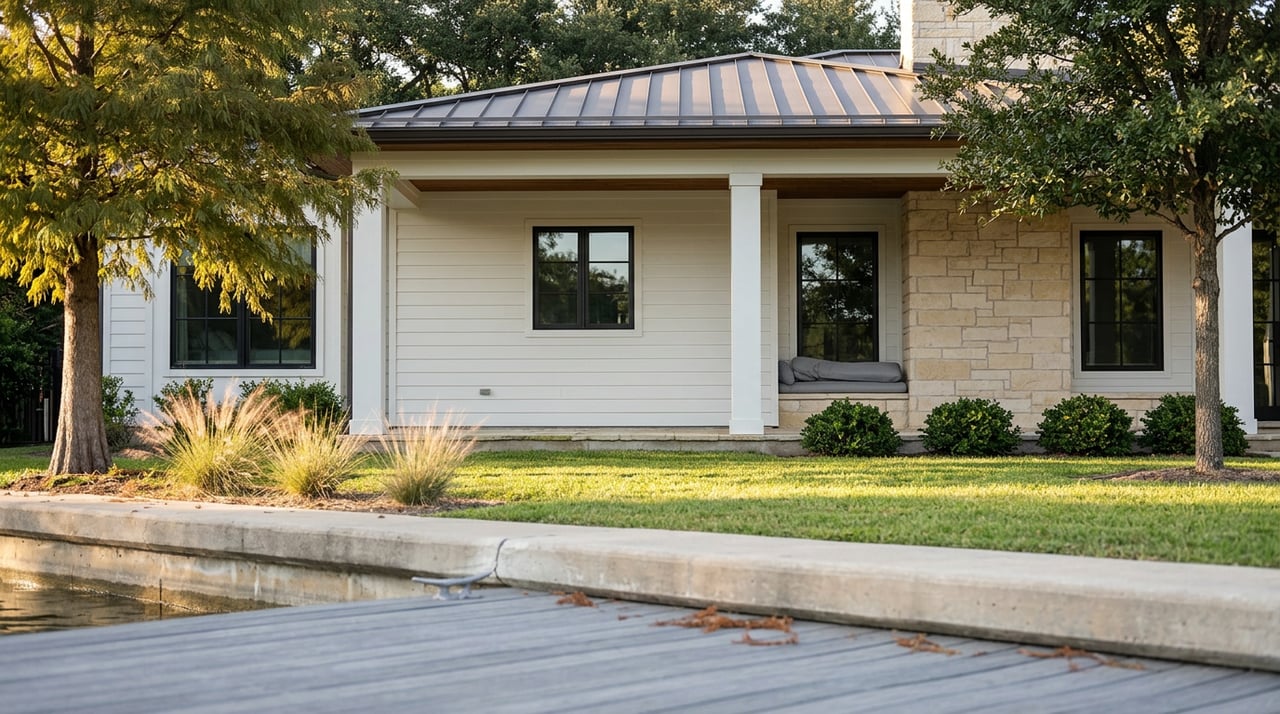
A seller in Seven Coves walks a buyer's agent down to the bulkhead this month, and the water sits high and calm against the wall. No gaps, no exposed toe, no obvious trouble. It photographs beautifully. It also tells you almost nothing about whether that bulkhead will still be standing in five years.
That is not a knock on the seller or the listing photos. It is a fact about how Lake Conroe is managed. As of August 7, 2026, the reservoir sat at 98.0 percent of conservation pool, which means most shoreline on the Willis side is close to a full, forgiving waterline right now. The stress that actually breaks a bulkhead, the scour at the base, the gap where backfill has washed out, the corrosion at the waterline, shows up when the lake drops, not when it is full. And the one predictable window when Lake Conroe drops on purpose has already come and gone for this year.
The two months when your dock tells the truth
Since 2018, the San Jacinto River Authority has managed Lake Conroe under a policy it calls Active Storm Management. From April 1 through June 1 each year, the City of Houston, which owns two-thirds of the reservoir's water rights, can request that SJRA lower the lake from its normal pool of 201.0 feet above mean sea level down to as low as 200.5 feet, opening storm capacity ahead of hurricane season. A separate drought contingency plan triggers watering restrictions if the lake falls to 199 feet.
Half a foot does not sound like much. On a bulkhead, it is exactly the band where toe erosion and hidden gaps become visible instead of submerged. A seller who lists in July or August, after the spring drawdown has ended and the lake has refilled, is showing a buyer the shoreline at a higher water level, when submerged areas are less visible.
That is not a reason to delay a listing. It is a reason to have already done, or to schedule now, the one inspection that does not depend on lake level: a marine contractor or structural engineer who can read the wall itself, not just the water in front of it.
A dock that looks perfect in August and a dock that is actually sound are two different claims. Only one of them survives an April inspection.
Reporting by The Inspector Man on Montgomery County lakefront inspections has documented what that gap can cost. A bulkhead failure in Bentwater ran the seller roughly $92,000 in full replacement. Rotted pilings and decking on a dock in Walden, priced around $63,000 to repair, led the buyer to walk and choose another property. Undisclosed water intrusion behind a vinyl bulkhead in Seven Coves, the community closest to the Willis shore, carried a remediation cost near $48,000.
| Community | Issue found | Approximate cost | Outcome |
|---|---|---|---|
| Bentwater | Bulkhead collapse | $92,000 | Seller paid full replacement |
| Walden | Rotted dock pilings and decking | $63,000 | Buyer terminated, purchased elsewhere |
| Seven Coves | Undisclosed water intrusion behind bulkhead | $48,000 | Remediation cost negotiated post-inspection |
Each was found during a buyer's option-period inspection, at which point the seller is negotiating from a weaker position than if the same defect had been found and priced in May, before the lake photographs looked flawless again.
A permit is not a deed
The physical wall is one half of the file. The other half is paperwork, and it is the half most sellers assume simply comes with the house.
It does not. SJRA's own licensing rules state plainly that the right to construct, operate, or maintain a private structure on Lake Conroe is not an inherent right of waterfront ownership. A dock, lift, or bulkhead requires its own permit, an annual fee is assessed based on the structure's size and location, and the permit can be revoked at any time. Construction cannot begin without the permit displayed, and a structure built without one can be subject to removal orders and fines from both SJRA and Montgomery County.
For a seller, the practical question is not whether a permit exists somewhere in a drawer. It is whether the permit file is ready for a buyer to review before closing. A buyer's title company will ask. A buyer's agent should ask. The seller who has already pulled the answer is the one who keeps the timeline intact.
Before listing, a Willis waterfront seller should be able to hand over:
- The current SJRA permit or license number for the dock, lift, and bulkhead, with a copy of the license agreement itself
- Any correspondence from SJRA, including notices of violation or stop-work orders, resolved or not
- A recent survey showing the structure relative to the property line and the shoreline easement
- If the home uses septic, the OSSF permit or tag, since properties within 2,075 feet of Lake Conroe need an SJRA permit as proof of sewer under Montgomery County's own permitting rules
Two approvals, one file
Willis waterfront communities layer a second approval process on top of SJRA's, and it is easy to miss because it lives with the homeowners association instead of a government agency.
Seven Coves, chartered as an association since January 1972, requires owners to submit an Architectural Control Committee packet before changing the exterior appearance of a home or lot, and the examples the association lists include additions, fencing, driveway extensions, and roof or exterior changes. A bulkhead repair or dock rebuild sits squarely in that category. SJRA's own bulkhead permit agreement makes the stakes explicit: the permit becomes automatically void if the permitted structure or activity is found to violate a deed restriction or covenant running with the land.
The fix is not complicated. It is simply a second file, kept alongside the SJRA paperwork, showing the Architectural Control Committee signed off. A buyer's attorney or title company checking both boxes closes faster than one checking only the government side and discovering the HOA side later.
What actually sets the price inside the bundle
Waterfront pricing on Lake Conroe is often read as a single premium over inland comparable sales. It is closer to two prices stacked together: the house and lot on one hand, and a bundle of dock, bulkhead, boat lift, and the permits that make all of it legal on the other. Strip the permits and the second part of that bundle is worth nothing to the next owner, regardless of how the structure looks in a listing photo.
Inside true waterfront communities like Seven Coves, the working pattern is that the middle of the price range reflects a mid-condition dock, a mid-condition bulkhead, and a permit. A listing priced above that midpoint is usually paying for newer marine construction or deeper water access. A listing priced below it usually has something in the bundle aging out or missing outright, whether that is a lapsed permit, a bulkhead nearing the end of its service life, or an HOA file with no ACC approval on record.
For a seller, that means the permit file and the inspection report are not paperwork to produce reluctantly during option period. They are the evidence that justifies where the listing sits in that range.
A practical sequence for a Willis waterfront seller preparing to list:
- Pull the current SJRA license agreement and confirm the fee status is current
- Schedule a marine contractor or structural engineer to inspect the bulkhead and dock now, rather than waiting for the buyer's option period
- Request the HOA's Architectural Control Committee file to confirm any past dock or bulkhead work was approved
- If the home uses septic, gather the current OSSF permit and maintenance records
- Price and disclose any known repair needs, since a full August lake can make some conditions less visible before a buyer's fall inspection
Frequently asked questions
What should I check about an SJRA dock or bulkhead permit before I sell? Have the permit file ready for review before listing rather than leaving it for the buyer's title company to discover during option period.
My house is near Lake Conroe but not directly on the water. Does any of this apply? If the property is within 2,075 feet of the lake and relies on septic, Montgomery County requires an SJRA permit as proof of sewer before the county will issue certain permits. It is worth confirming distance and septic status even for near-water, non-waterfront homes.
When is the best time to actually see whether a bulkhead is failing? Historically, during SJRA's Active Storm Management window, April 1 through June 1, when the lake can be drawn down to as low as 200.5 feet. A structural inspection performed at that time, or a review of photos and reports from that window in a prior year, reveals conditions a full summer lake will not show.
If you are weighing a listing on the Willis side of Lake Conroe, whether it is a canal lot in Seven Coves or open water further up the shoreline, getting the permit file and the structural picture right before the sign goes in the yard is the work that actually protects your price. Aqua Terra Real Estate has spent years walking Willis waterfront through exactly this process, from the SJRA paperwork to the HOA approvals to knowing which contractor to call first. Reach out when you are ready to talk through what your dock, your bulkhead, and your permit file are actually telling a buyer.
This article is general information, not legal, tax or financial advice. Consult a qualified professional about your situation.