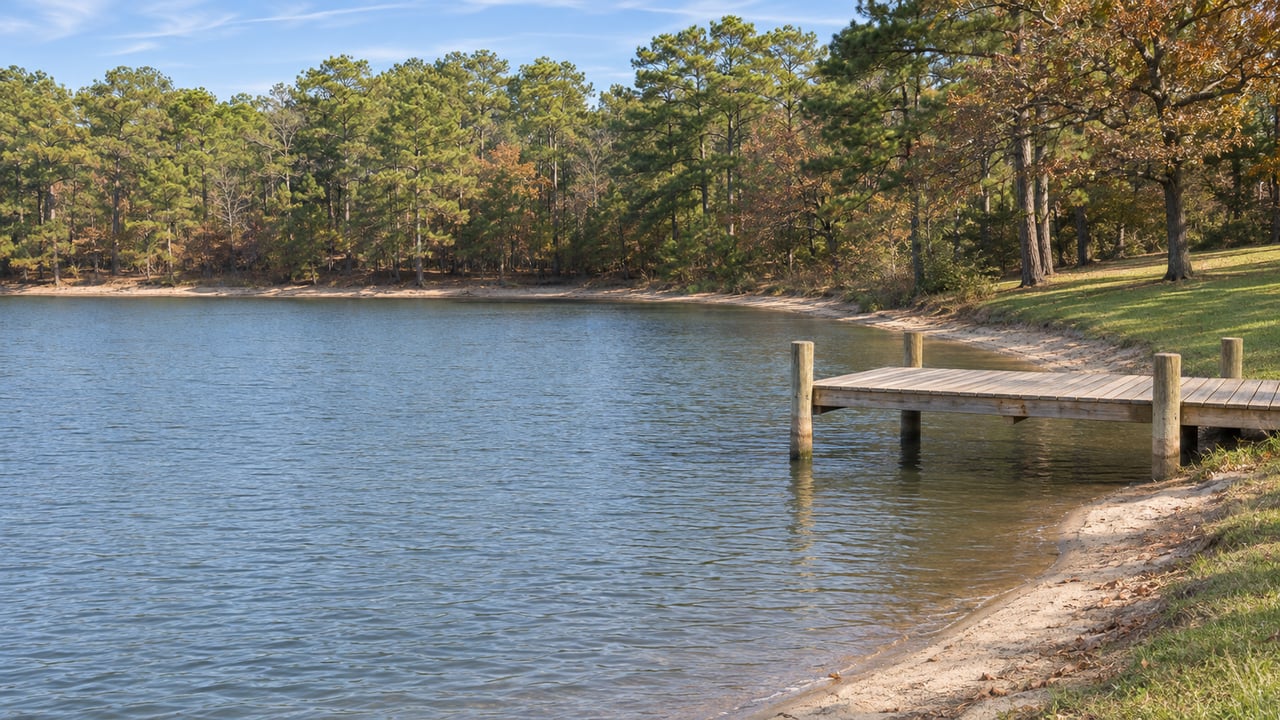
Bird Island sits in the water off Seven Coves and Harbour Town. It is a low rise of land that water birds use for roosting. According to a KSAM report from this April, which drew on The Courier of Montgomery County, organizer Madi Bullock says the island has shrunk from about two acres to about a quarter of an acre. This fall the water around it is lower than it has been in a while. On Nov. 7, Water Data for Texas put Lake Conroe at 199.31 feet. That is 92.1% full and about 1.7 feet below the 201-foot conservation pool.
Nobody released water from the dam to make this happen. Lake Conroe has had no seasonal lowering program since spring 2024. The low water you see from a Willis dock this November comes from evaporation, steady water withdrawals and a drought that has run for two years. On the north end, the effects show up as thicker vegetation, a smaller island and more of the upper lake's old timber close to the surface.
How the lake got here without a release
The state's daily readings show the water dropping steadily since late summer:
| Date | Mean level | Below the 201-ft pool | Surface area |
|---|---|---|---|
| Nov. 7, 2025 | 199.94 ft | 1.06 ft | 19,321 acres |
| Aug. 7, 2026 | 200.57 ft | 0.43 ft | 19,662 acres |
| Oct. 7, 2026 | 199.85 ft | 1.15 ft | 19,273 acres |
| Nov. 7, 2026 | 199.31 ft | 1.69 ft | 18,981 acres |
From early August to early November the lake fell about 15 inches. Over that time the open water shrank by roughly 680 acres. The lake also sits about 7.5 inches lower than it did on the same date last year.
In 2024, the Lake Conroe Association (LCA) reported that at the San Jacinto River Authority's April 25, 2024 board meeting, the SJRA general manager announced that the Seasonal Lake Lowering Program, in place since 2018, was over. A new program called Active Storm Management replaced it. By September 2025, the association said there had been no written lowering protocol since January 2025.
So the water is going out in other ways. In its July 14 letter, the LCA put SJRA withdrawals at about 20 million gallons a day. The letter says the lake usually drops 15 to 30 inches from summer evaporation alone, until fall and winter storms refill it. The same letter says the lake stayed below normal pool for more than nine months, from late August 2025 to mid-June 2026. It reached 201 feet in mid-June and held there for about two weeks. Then evaporation and withdrawals pulled it under again on June 29.
LCA president Kevin Lacy's August 20 letter gave the full-year count. Between July 2025 and July 2026, the lake was at or above full pool for only about six weeks, a little more than 10% of the year. The letter added:
"Long term residents are asking why the water levels are low, dropping so much daily, and staying lower longer."
The fall and winter rains are what refill the lake, and in 2025 they never came. The July letter says moderate drought kept the lake from recovering last year.
Why low water is harder on the north end
Lake Conroe has two different halves. The Texas Parks and Wildlife Department's lake page says the lower two-thirds is mostly open water lined with bulkheads and boat docks. The upper reservoir, the part inside the Sam Houston National Forest, still has standing timber along the old river channel. TPWD notes that most of that timber is only slightly underwater even when the lake is full, which makes those areas hazardous for boats. At 1.7 feet below full pool, the same stumps are that much closer to a prop.
The vegetation is the other north-end problem. The LCA's July letter said the northern part of the lake "continues to struggle with both Hydrilla and several other invasive species." It also said SJRA's spraying had been set back by equipment problems, and it asked boaters to stay out of heavily infested areas so they don't foul props and intakes or spread the plants. The August letter said TPWD's May 2026 hydrilla survey showed a significant increase in coverage in several parts of the lake compared with 2025.
In its Oct. 8 letter, the association said it expects TPWD's fall survey to show significant growth in both hydrilla and other invasive plants compared with 2025. It gave two reasons: warmer water, and spraying by both TPWD and SJRA that was delayed in August and September. The LCA plans to raise the 2026 problems, grass carp restocking numbers and better communication during spraying season at the Lake Conroe Habitat Advisory group.
Two Lake Conroe residents, Michael Hallett and Madi Bullock, started an awareness campaign for Bird Island in 2024. This year Bullock teamed up with Sam Perrigue of Tx Dock Vibes on a petition. KSAM reported that TPWD had earlier called a rehab a multimillion-dollar project it did not have the money for. The organizers set a goal of 10,000 signatures by Labor Day, after which they would bring a rehabilitation plan and budget to SJRA. Lake Life Solutions offered a free site survey to estimate the cost of dredging, riprap, no-wake zones and signage. The LCA has given the Save Bird Island Initiative technical advice, a seat for one of its board members and $5,000 toward start-up costs.
Who decides whether the lake goes lower
Even without a lowering program, the question of when water leaves the lake is still being worked out, and the City of Houston has the biggest say. SJRA's March 2026 explainer says the City of Houston owns two-thirds of Lake Conroe's water rights, and SJRA releases Houston's water when the city requests it. The same explainer says an October 2025 permit amendment raised the maximum water-supply diversion rate from 700 to 2,000 cubic feet per second. That changed how fast water can be diverted. It did not set a lowering schedule or a target lake level. In July, Community Impact reported an SJRA official saying the City makes the decision to lower the lake, not SJRA.
Lowering keeps coming up because of flooding downstream, where the long-term fix is running years behind. The LCA's October letter says the planned spillway gate expansion at the Lake Houston dam was first promised for 2024. It is still in design and is now expected to be working no earlier than 2030. Until then, lowering Lake Conroe before storms remains an option. The association funded its own study by Bleyl Engineering, finished in August, which concluded that lowering Lake Conroe gives effective flood benefits only in the area just below the dam. The study found it does not meaningfully reduce flood levels at Kingwood and Lake Houston.
Residents do have a process to follow. After meetings that included State Representative Will Metcalf and Montgomery County Judge Mark Keough, SJRA verbally committed that any future lowering would go through public notice and review, according to the LCA's July letter. The larger joint reservoir operations study is looking at how Lake Conroe and Lake Houston could be run together once the new spillway gates exist. That includes whether lowering before storms is workable and how it would affect water supply. The study's second public meeting was held Nov. 5 at the Lone Star Convention & Expo Center in Conroe.
The dates that will shape the lake this winter
The lake level on any given morning depends on rain. These are the points where decisions about the lake get made in public:
- Dec. 10, 2026. The next regular SJRA board meeting, as listed on the board's Oct. 22 agenda. That agenda had no seasonal drawdown item.
- TPWD's fall vegetation survey. In October the LCA said it was waiting on these results, which will set the hydrilla discussion at the Habitat Advisory group.
- Early 2027. The LCA says a program of oil and gas lease sales near Lake Conroe and in the Sam Houston National Forest is moving toward approval, with limited public review.
- Spring 2027. SJRA's posted schedule for the joint operations study has the draft report due then.
For a day on the water before then, the Water Data for Texas page updates the lake level hourly. It's worth a look before you take a boat into the timbered upper end or the coves where vegetation has been heaviest. The Nov. 7 reading of 199.30 feet was the most recent when this post was written. A wet December would change it quickly, and another dry winter would push it lower.
How the lake level changes shoreline, docks and boat access on the Willis end is something we pay close attention to at Aqua Terra Real Estate. If you have questions about how this season's water is affecting a north-shore property you own or are considering, we're glad to talk it through with you.